Initial mindset
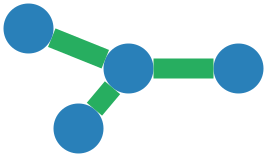
Causal thinking, searching for ( root ) causes is our intuitive brain’s best buddy, preventing that failures happen. To increase output, we need to control the nodes. It’s a highly effective strategy for relative simple challenges, in a world of scarcity. Accepting a bit more complexity in this process of getting control is a necessary side-effect we willingly embrace.
Industrial mindset 🏭
Function profiles, effort in man-days, and milestones are established to gain control over the output. Hierarchy provides the overview and control needed. This ensures we waste as little time as possible and convert as much input as we can into promised output.

The X-axis represents the complexity, the Y-axis the productivity.
Intuitive focus on efficiency drives us to the right, towards more control but also as side effect more complexity. Over time, the productivity loss because of the complexity is not a side effect any more and higher then the gain obtained with the well intended efficiency. The well-established strategy becomes contra-productive, and we must change our approach, to reduce complexity, against our intuition. The 2 arrows in opposite directions visualize the conflict between more efficiency and less complexity.
Changed mindset
Reality catches up with us. Increasing complexity decreases the ability to keep all possible causal relations ( of all connections ) in control, affecting the productivity of the environment. A statistical reasoning proves to be much more effective in a world of abundance. Unfortunately, our intuitive brain still prefers causal thinking seeing complexity as a side effect. We must now interpret our experience and learn to understand the effect of complexity, focus on it to reduce it to achieve more agility..
Agile mindset 🧪
Routine and short feedback cycles are implemented in self-managing teams to quickly learn from our inevitable mistakes and ignorance, aiming to gain control over the unpredictable world. We embrace mistakes as opportunities to experience and learn rapidly what true value outcomes are. Structures of control add complexity, hamper feedback cycles for learning so become impediments which need to be removed.